
Security glass engineered to withstand manual attack
Tecdur Secure Glass is built to protect people, premises and valuables from smash-and-grab, forced entry and prolonged, determined attack. The level you need is set by the standard: EN 356 for anti bandit glass, or LPS 1270 where attack is likely to be sustained. Every panel is made to order for your project and your level of risk.
Secure Glass ratings — what each level means and how it's tested
Tecdur Secure Glass is tested to EN 356 and certified to LPS 1270.
What it needs to perform
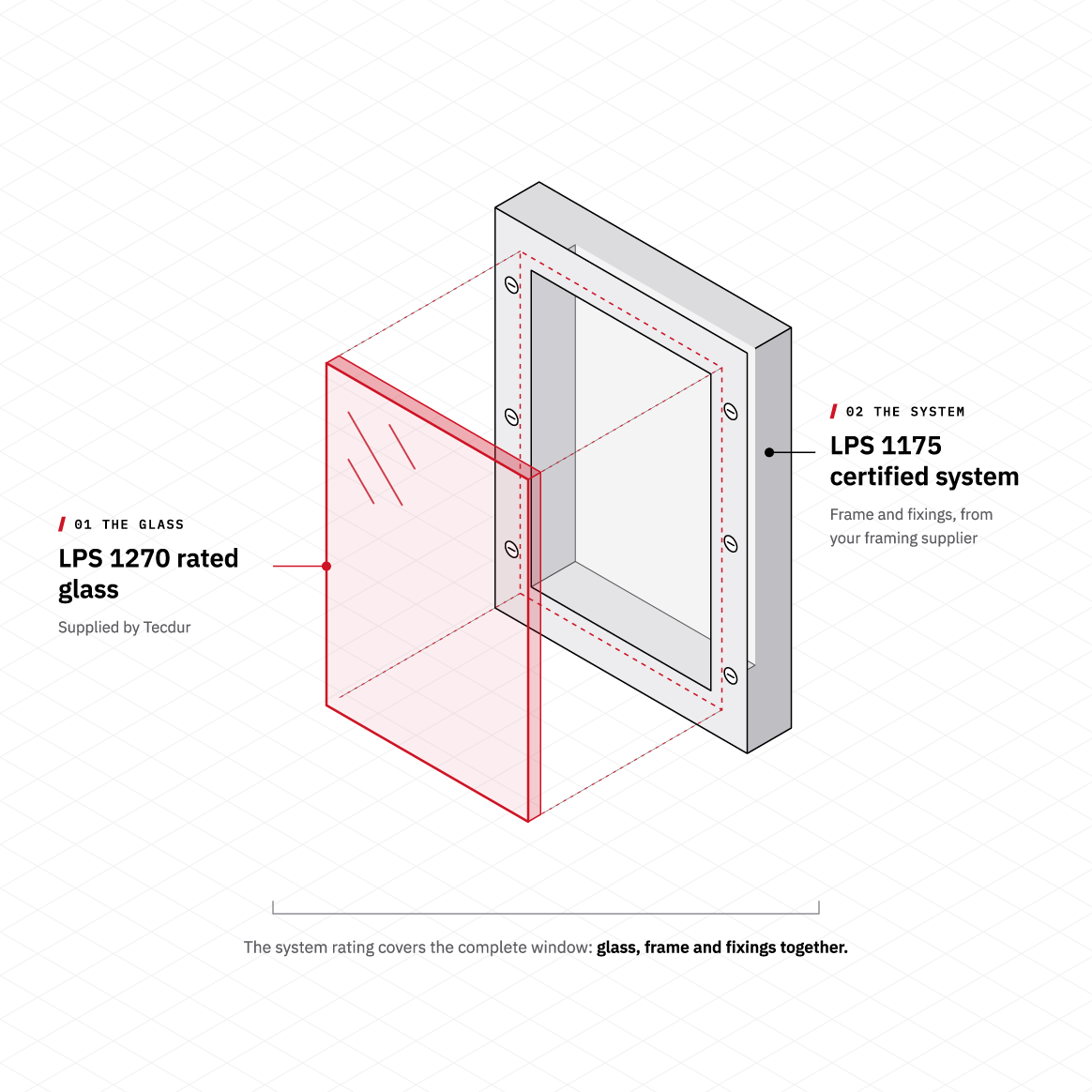
Glass designed to work within a certified system
Tecdur Secure Glass is LPS 1270 rated glass, designed for an LPS 1175 certified system. Where those standards may not strictly apply, as in prisons, police stations, young offender centres and mental health settings, our customers self-certify the framing. Some jewellers knowingly use untested frames for smash-and-grab protection.
- LPS 1270 rates the glass we supply
- LPS 1175 rates the complete frame or system
- Self-certified systems are also an option
Applications
Who Secure Glass is for
-

Security doors
Vision panels for steel security door and framing manufacturers.
-

High value retail and commercial
Shopfronts and street-facing windows exposed to smash-and-grab.
-

Prisons and police custody suites
Glazing that resists escape attempts and sustained attack from inside.
-

Mental health establishments
Glazing that balances security with the safety of the people inside.
-

Secure facilities
Critical sites specifying the higher LPS 1270 levels.
-

VIP protection
Glazing around people who face a targeted, determined threat.
Combined Requirements
Where one panel has more than one job
Where the same glazing faces more than one risk, Secure Glass can be combined with other Tecdur products. Tell us every risk it faces and we'll work out the build with you. If one of these is your main requirement rather than an addition, follow the link to that product.
Tell us your requirements-
 Fire
For fire doors that must also resist forced entry
-
 Ballistic
For sites where forced entry and armed attack are both a risk.
-
 Blast
For buildings where forced entry and an explosion are both a risk.
-
 Privacy
For rooms that need discretion without giving up security.
-
 Acoustic
For rooms that need to keep out noise as well as intruders.
Testing Footage
See our Secure Glass under attack
Independent testing is what gives a rating its value, so our rated products are tested at accredited external laboratories. Watch the testing footage here, and find more for every product in our resources.
Start an Enquiry
Tell us what you need to secure
A member of our team will come back to you within 24 hours. The more you can tell us about the size and the standard, the faster we can help.
By submitting this form I accept the Privacy Policy of this site.
Frequently asked questions
Which security standard should I choose for my application?
EN 356 is typically used for retail, commercial and general security applications where protection against smash-and-grab or forced entry is required, while LPS 1270 is specified for higher-risk environments such as prisons, police custody suites, mental health facilities, VIP protection and high-security buildings. Tecdur works with customers to specify the correct standard and rating based on risk level, regulatory requirements and project needs.
What is LPS 1270 security glass and why is it different?
LPS 1270 is a UK security glazing standard developed by the Loss Prevention Certification Board following consultation with police forces and insurers. It is designed to simulate more realistic manual attack scenarios using a wide range of tools over timed periods of up to 10 minutes. Glass is classified using a three-digit code that measures resistance to creating progressively larger openings, from a small hole to pass a wire through, to a hand-sized opening, and finally an aperture large enough for a human torso. LPS 1270 certification is particularly important for high-security environments where prolonged and determined attack is a risk. Tecdur Secure Glass is certified to LPS 1270 SR1 through SR6 and is subject to ongoing audits by the Loss Prevention Certification Board to maintain compliance.
What is EN 356 security glass and what do the ratings mean?
EN 356 is a European standard for security glazing, commonly known as anti-bandit glass. It measures a glass panel’s resistance to manual attack. Lower ratings from P1A to P5A are tested using repeated steel ball drops to simulate impact and forced entry attempts, while higher ratings P6B, P7B and P8B are tested using repeated axe strikes. P6B requires the glass to withstand 30 to 50 axe strikes before an opening is created, P7B withstands 51 to 70 strikes, and P8B withstands more than 70 strikes. EN 356 ratings help customers choose the correct level of protection for high-value retail, commercial buildings and secure environments. Tecdur Secure Glass is certified across the full EN 356 range to ensure proven resistance to attack.
What is Tecdur Secure Glass?
Tecdur Secure Glass is an enhanced security glazing solution engineered to resist severe manual attacks. It is widely used to protect high-value assets, prevent break-ins, and ensure safety in high-security facilities.
What certifications does Tecdur Secure Glass hold?
Tecdur Secure Glass is certified to EN 356 and LPS 1270 standards. EN 356 certification (P1A to P8B) assesses the glass’s resistance to various impact levels, while LPS 1270 certification (SR1 to SR6) evaluates its performance under realistic manual attack scenarios.
What is EN 356 anti-bandit glass?
EN 356 anti-bandit glass is a classification for glass resistant to impacts, such as those from heavy objects like steel balls or axes. The highest levels (P6B to P8B) require the glass to withstand numerous axe strikes, making it highly resistant to forced entry.
How is LPS 1270 security glass tested?
LPS 1270 glass undergoes rigorous testing that simulates real-world attack scenarios. The classification (e.g., LPS 1270 1.1.2) measures the glass’s resistance to hole creation, using different tools and time intervals, to assess its ability to withstand various breaches.
Where is Tecdur Secure Glass commonly used?
Typical applications include high-value retail and commercial properties, VIP protection, prisons, police custody suites, mental health facilities, and high-security installations. It’s also used in security doors and windows for areas requiring high levels of protection.
What does the three-digit LPS 1270 code mean?
The three-digit code specifies the glass’s resistance level for creating holes of different sizes. The first digit rates resistance to small holes (sufficient for wire access), the second for hand-sized openings, and the third for larger apertures big enough for a human torso.
What tools are used in the LPS 1270 testing?
A range of tools simulating real-life break-in attempts are used in LPS 1270 testing. These include hammers, chisels, and other tools, progressively increasing in force to assess the glass’s durability against realistic attacks.
How long can Tecdur Secure Glass withstand an attack?
Tecdur Secure Glass is tested to endure attacks for extended periods, up to 10 minutes, depending on the certification level. Higher LPS 1270 ratings correspond to increased resistance times, making it challenging for intruders to breach the glass.
How does Tecdur Secure Glass benefit mental health facilities?
In mental health establishments, Tecdur Secure Glass provides both security and safety by preventing unauthorized exits and protecting individuals from harm. Its durability and anti-bandit features make it suitable for such sensitive environments.
Can Tecdur Secure Glass be custom-fitted for specific projects?
Yes, Tecdur Secure Glass can be tailored to meet the requirements of various high-security applications. Tecdur’s team works closely with clients to ensure the chosen glass matches specific security needs, whether for retail, government, or secure facilities.
What maintenance is required for Tecdur Secure Glass?
Tecdur Secure Glass is designed to be low maintenance; however, regular cleaning and periodic inspections are recommended to ensure long-term durability and effectiveness in high-security environments.